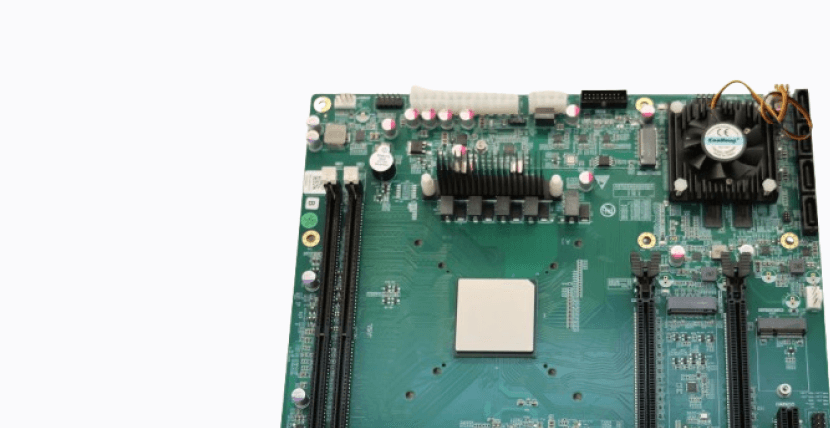
I built my daily driver about a year ago. Ryzen 5 5500, AM4 socket, DDR4. I didn't want to spend extra on AM5 at the time.
I do wish I got more RAM but I have yet to regret the AM4 or R5 5500 choice.
I don't game. I code. Docker works fine. VS Code/ Antigravity runs fine. I open Blender sometimes, DaVinci Resolve, Shotcut, a dozen browser tabs across multiple browsers, Python and TypeScript tools simultaneously — all fine. I've run GROMACS molecular dynamics simulations on it. I've trained models on it.
Nothing breaks. Model training isn't always fast, but I don't really work with vision models. I just head out if it takes too long. I like walks, so it works in my favor.
I've been curious about what's actually happening in the CPU market. AMD's position, what's coming next, and whether the Chinese chip manufacturers are actually catching up.
AMD is quietly winning
Right now, AMD now ships roughly 30% of all x86 CPUs by volume and over 35% of desktop CPUs. On revenue, AMD controls about 35% of x86 CPU dollars, which means AMD is winning the expensive end of the market.
Intel does sell majority chips, but they're losing ground in premium desktop/server market, their own management has said they're unlikely to recover until late 2026 or 2027.
Intel's Arrow Lake didn't perform that well, and AMD's Zen architecture gave solid IPC improvements. 9800X3D and 9850X3D became the gaming benchmarks. AMD's EPYC processors hit 41% of x86 server CPU revenue in Q4 2025 (that's for servers).
I usually think AMD chips run hotter and Intel chips are more expensive, akin to Apple's devices in a way, but AMD does seem to have a significant market share these days.
What's current and coming
Now: On the AM5, 9850X3D is the gaming flagship. 8 cores, 104mb cache, upto 5.7 Ghz boost. Ryzen AI 400 series is new for laptops, basically AI 300 refresh with slightly higher clocks. I think Ryzen AI Max+ that uses unified upto 128GB is more impressive. That's what devices competing with Mac studio are running.
Coming: Zen 6, Olympic Ridge is probably not landing in 2026. AMD says Zen 6 is on 2nm TSMC and will come to EPYC server chips- but it might be 2027 before that comes to desktop Ryzens.
When it does arrive, AMD is moving from 8 core CCDs to 12 core CCDs. This means, the desktop chip could hit 24 cores and 48 threads in dual CCD config, with new core count tiers at 10 and 20. It's supposed to be on AM5. TSMC 2nm. Probably with support for AI baked in.
What this means for me
if Zen 6 desktop isn't coming until 2027, if you're on AM5, you're just sitting with Ryzen 9000 and paying high prices for DDR5 RAM. DDR4 is still much cheaper. I think a 2027 Zen 6 desktop launch partially exists because AMD wants better DRAM pricing conditions.
My R5 5500 is Zen 3 (2021) and it's not going to win benchmarks against a 9800X3D. But it works for most things I do today. I think it makes no sense for me to upgrade to AM5 right now, only to wait another year to upgrade to Zen 6. AM5 would support Zen 6, but I'm not building new and I simply don't care.
Are Chinese chips catching up to AMD and NVIDIA?
Honestly, it's hard to tell. From what I've found - yes and no.
Loongson has its own LoongArch ISA (mix of MIPS and RISC-V; not compatible with x86) chips.
A Phoronix Linux benchmark (Feb 2026, very recent) put 3B6000 (a 12-core consumer chip) at roughly three times slower than AMD's six-core Ryzen 5 9600X. It has a clock speed around 2.5GHz, supports DDR4/5 and is better than early RISC-V boards. The post doesnt mention power usage.
Loongson chips are made to run on Loongnix or Chinese Linux distros. It makes sense that they won't perform that well on things that need optimization. They are deployed in space, but I don't think they are meant to be consumer chips or competitive globally.
Zhaoxin uses x86, meaning they run Windows, standard Linux, normal apps. The current KX-7000 desktop chip performs close to i3-8100 levels from 2017.
The server side looks interesting. Zhaoxin has the KH-50000, a 96-core server chip using a designthat looks like AMD's EPYC (large IO die in mid, compute dies around it). 12-channel DDR5, 128 PCIe 5.0 lanes. On paper, the it looks great. Sucks there are no benchmarks on this.
Haiguang (Hygon) makes x86 server chips derived from earlier AMD Zen/Zen+ designs under some licensing deal. Their C86 series improves 15-30% per generation and boasts AMD-ish performance without exposure to US supply chain.
Frankly: Chinese consumer chips are 5–7 years behind AMD and Intel. Server chips are getting closer, but I doubt if performance-per-clock is identical. I think Chinese companies are trying to run critical infra without relying on US exports, and they're doing great for that objective.
What about Chinese GPUs?
China is simply behind on CPUs. On GPUs, it's still behind, but it's nuanced.
Moore Threads launched MTT S80 (2022) with 16GB DDR6, running on PCIe 5.0 x16, but performing poorly than a GTX 1050 Ti (2016), consuming more power. In 2024/5, they've worked on driver updates that apparently boosted performance by up to 80% in S80.
Their next card MTT S90 is on par with RTX 4060 in many tests. That's very good. From 1050 Ti to roughly RTX 4060 territory is great.
There's another problem. Benchmarks haven't been verified by international reviewers. Chinese GPUs dont land on Western review benches.
Moore Threads announced "Huagang" in late December, and a gaming GPU built on it - "Lushan." 15x gaming performance boost, 50x ray tracing boost. I don't trust marketing team on the numbers.
And there's the software problem. Intel Arc hit driver compatibility issues on launch. Moore Threads has their own MUSA programming framework, doesn't really support DirectX, and that means direct comparisons aren't possible. Not for most games anyway.
Biren, Moore Threads, MetaX, and Enflame make the most AI chips in China.
Biren's flagship, BR100, is built on a 7nm chiplet design and has roughly A100-level performance.Biren was placed on the US Entity List (2023), which cut off TSMC access for their most advanced designs. They've lost 9 billion yuan in losses in the first half of 2025 alone- and pivoting to simplified BR106 variants likely manufactured at SMIC, China's domestic fab.
MetaX launched C600 chip in late 2025 with 144GB HBM3e memory, same as Nvidia's H200. MetaX is specifically focused on CUDA compatibility, Their stock surged nearly 700% on the first day, which will probably go into R&D. I think it's interesting, and I'd love to get my hands on one, but I have my concerns.
I think the hardware gap is closing fast, but Nvidia's CUDA ecosystem has cuDNN, TensorRT, cuBLAS and without deep software integration into Chinese chips, it's a war they can't win with hardware alone.
Export control chaos
Biden started restricting advanced chip exports to China in 2022, so Nvidia couldn't really sell advanced chips. Nvidia launched H20 - a downgraded chip that could slip under export thresholds, and Chinese companies bought a lot. Then, Trump tightened restrictions again. Then, reversed them three months later, allowing H20 and AMD MI308 sales. Then, China warned domestic companies away from the H20 and pushed them toward domestic alternatives.
Meanwhile, Nvidia is developing another new chip for China, said to be roughly half as powerful as B300 Blackwell. China is 13% of their revenue, so it makes sense.
I think US export restrictions and chaotic policies are partly what led Chinese domestic GPU makers to get state money for R&D.
CUDA
CUDA is native framework for NVIDIA hardware. It's basically just a compatibility layer for chips that aren't made by NVIDIA. "CUDA support" from Chinese manufacturers is not the same as native support.
I don't think a chip matching H100 on benchmarks automatically does well on a data center with CUDA-optimized code.
Software is the real issue here.
Final Thoughts
I'm not upgrading my PC this year. I see no compelling reason.
AM5 with Zen 5 is genuinely better than what I have, but not so much better that it matters for my workload. Zen 6 desktop is likely 2027. If that lands with AM5 compatibility (which seems probable), maybe I'll upgrade the chip, keep the platform.
The Chinese chip story is a good lesson. I can see China running it's critical infra entirely on domestic silicon, and other countries following suit. It's not - China is catching up AMD. It's more - China is building a domestic ecosystem that doesn't need AMD/ Intel.
Ryzen 5 5500 still works fine. Next upgrade probably 2027.